First-time assessment of particle release from IOLs – are contact lenses next?
Microplastics are increasingly recognized as a potential health concern – not only from environmental exposure but also as a possible byproduct of medical devices. With over 30 million intraocular lenses (IOLs) implanted annually, their long-term material stability is of critical importance. A recent experimental study presented at the 52nd EFCLIN Congress provides reassuring data: no measurable particle release from modern IOL materials was detected under controlled conditions. Notably, identified polymer particles were primarily linked to packaging materials rather than the lenses themselves. These findings shift the focus toward the broader system surrounding ophthalmic devices and raise important questions about comparable risks in contact lenses and their care solutions.
Microplastics have become a topic of increasing global attention, not only in environmental science but also in medicine. It has been estimated that humans may ingest up to five grams of microplastics per week, amounting to roughly 20 kg over a lifetime. Potential biological effects such as inflammatory responses, oxidative stress, disruption of cellular signaling pathways, and even malignant transformation are currently under investigation. While much of the focus has been on environmental exposure, medical devices themselves have recently emerged as a potential direct source of micro- and nanoplastics within the human body.
Several studies have demonstrated that medical materials can release particles under certain conditions. For example, increased microplastic concentrations have been detected in the air during surgical procedures. Coronary catheters have been shown to release particles under laboratory conditions, and absorbable sutures can generate a significant number of polymer fragments. These findings raise an important question: could intraocular lenses (IOLs), among the most frequently implanted medical devices worldwide, also be a source of particle release?
With more than 30 million IOLs implanted annually, this question is of substantial clinical relevance. It is somewhat surprising that this aspect has not been systematically analyzed until now. IOLs remain in the eye for years or even decades, making long-term material stability a critical consideration.
Study objective and design
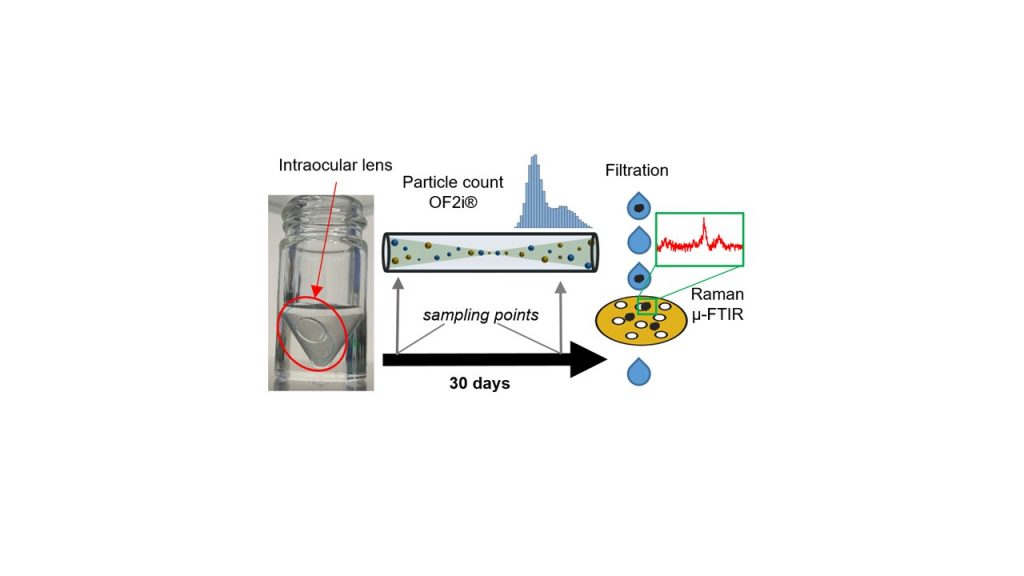
The aim of the study by Borkenstein et al. was to investigate whether modern intraocular lenses release particles under controlled conditions. To address this, the authors designed a highly controlled in vitro experimental setup that isolates material-related effects from environmental influences. Seven commonly used IOL models from major manufacturers were selected, representing hydrophobic acrylic, hydrophilic acrylic, and PMMA materials. These lenses were chosen not only to compare different material classes but also because they reflect widely used models in clinical practice.
A key challenge in studying particle release from IOLs lies in the expected low number of particles and the long implantation time in vivo. Therefore, a very sensitive and combined analytical approach was required.
Methodological approach
To overcome the limitations of individual analytical techniques, the authors employed a multimodal approach combining optofluidic force induction (OF2i) for time-resolved particle counting with Raman microscopy and μ-FTIR spectroscopy for chemical identification. OF2i is a novel technique that allows detection and characterization of individual particles directly in liquid without the need for filtration. It uses an optical vortex laser trap within a microfluidic system to capture and analyze particles, enabling measurement of particle number, size, and concentration over time.
In contrast, Raman and FTIR spectroscopy provide chemical identification based on molecular fingerprints. While highly reliable, these methods require sample preparation and do not allow continuous measurement. Their combination with OF2i therefore enables both temporal monitoring and compositional analysis.
The IOLs were stored in ultrapure, 0.02 µm-filtered water to minimize background contamination. This controlled environment was specifically designed to isolate potential particle release from the IOL material itself, separate from packaging-derived or environmental particles.
Results
Encouragingly, across all measurements, particle counts remained extremely low and comparable to control samples without IOLs. Importantly, no significant increase in particle numbers was observed over the 30-day observation period.
A central and clinically highly relevant finding emerged from the subsequent chemical analysis: no particles matching the chemical composition of the IOL materials were detected in this first evaluation period. Instead, the vast majority of detected particles could be attributed to environmental or background contamination.
However, in some cases, polymer particles such as polyethylene (PE) and polypropylene (PP) were found, particularly in packaging liquids. This represents a key result of the study: the detected polymer particles were not originating from the IOLs themselves but were predominantly associated with packaging materials and handling environments.
This distinction is critical, as it shifts the interpretation of particle presence away from intrinsic material instability of the implant toward external sources within the product ecosystem.
Validation experiments using polystyrene reference particles confirmed that the analytical methods were sensitive and reliable, capable of detecting particles of known size and concentration.
Interpretation and discussion
The results indicate that modern IOL materials exhibit high stability under controlled in vitro conditions. No evidence of spontaneous particle release from the lens material itself was observed within the 30-day timeframe of this initial study.
Crucially, the identification of PE and PP particles in packaging fluids highlights that the primary source of polymer particles is likely external to the implant. This finding reframes the discussion: rather than focusing solely on the IOL as a potential emitter, attention must be directed toward packaging systems, storage media, and handling processes.
In other words, the relevant source of particles may not be the implant itself, but the surrounding materials that come into contact with the lens before implantation.
At the same time, it is essential to consider the limitations of the study. The experimental setup was deliberately simplified to isolate material effects and does not replicate the complex biological environment of the human eye.
Key factors absent from the model include proteins and lipids in the aqueous humor, cellular interactions, mechanical stress and micromovements, as well as UV exposure and oxidative processes. These factors may influence long-term material behavior and cannot be assessed in a short-term in vitro model. Furthermore, the observation period of 30 days is limited compared to the actual lifespan of an IOL in the eye. While the results are reassuring in the short term, they do not exclude the possibility of long-term degradation or very low-level particle release below the detection threshold.
Complementary findings: the role of external stress
In a separate but related study, the authors investigated the effect of Nd:YAG laser capsulotomy on IOL materials. Under clinically relevant laser settings, fragments of approximately 10–20 µm were observed adjacent to laser-induced pits. Raman spectroscopy confirmed that these fragments originated from the IOL material itself. This demonstrates that while IOLs are stable under passive conditions, external stress – such as laser energy – can induce localized material damage and fragment release.
This highlights a critical distinction: the question is not only whether particles are released, but under which conditions.
Clinical and scientific implications
Taken together, these findings provide a nuanced perspective on IOL material behavior. Under controlled conditions, modern IOLs appear highly stable, and no spontaneous particle release was detected. Packaging materials may represent a relevant source of polymer particles, while external stress factors can induce material release.
For clinicians, this is reassuring in terms of routine implantation. However, it also underscores the importance of handling procedures and packaging design. From a research perspective, the study emphasizes the need for more realistic models that better mimic intraocular conditions.
For clinical optometric practice, this leads to an important extension of the research question: CLs – contact lenses should also be systematically evaluated for potential particle release, particularly with regard to long-term wear and material aging. In addition, rinsing and storage solutions should receive greater attention, as – similar to packaging solutions for intraocular lenses – they may represent potential sources of micro- or nanoparticles.
Given the significantly higher exposure time and direct environmental interaction of contact lenses compared to intraocular lenses, this aspect may be even more relevant in daily optometric practice.
In particular, repeated handling, cleaning, and storage cycles, as well as mechanical stress during wear, could represent additional factors influencing potential particle release in contact lens systems.
Furthermore, close collaboration between scientific institutions and manufacturers should be encouraged in order to create more realistic study conditions and to better analyze long-term behavior under everyday use conditions.
Future directions
Further investigations should focus on long-term studies over extended periods, simulation of intraocular conditions including proteins and lipids, mechanical stress and dynamic movement, UV exposure and oxidative aging, as well as the effects of surgical procedures such as injection and laser treatment. Such studies are technically demanding, time-consuming, and costly. Therefore, collaboration between industry, clinicians, and research institutions will be essential.
A coordinated approach would allow the generation of robust, clinically relevant data and accelerate understanding of long-term material behavior.
Conclusion
In conclusion, this first study demonstrates that modern intraocular lenses do not show measurable particle release under controlled in vitro conditions. The particles detected are primarily associated with packaging materials rather than the IOL itself. These findings are encouraging but must be interpreted within the limitations of the experimental setup.
At the same time, this investigation represents an important first step, and longer observation periods will be essential to fully evaluate potential long-term material behavior and particle release under clinically relevant conditions.
The absence of biological and mechanical factors means that real-world conditions are not fully represented. Future research should therefore focus on bridging the gap between controlled laboratory models and physiological environments. Only through such efforts can we fully understand the long-term behavior of intraocular lens materials. At the same time, these findings clearly extend beyond intraocular lenses: contact lenses – due to their widespread use, long-term application, and repeated exposure to care systems – should be considered a priority area for future investigation.
Particularly, the potential role of care solutions, storage conditions, and daily handling as sources of micro- and nanoparticles warrants systematic evaluation.
Ultimately, this represents a shared opportunity: a collaborative effort between industry and academia to ensure the highest level of safety and performance for one of the most widely used implants in modern medicine. Expanding this collaborative approach to the field of contact lenses will be essential to ensure equally high safety standards in everyday vision care.
In this context, the authors would welcome collaborative inquiries from industry partners to further investigate contact lens materials, care and rinsing solutions, storage conditions, and daily handling processes, and to develop innovative concepts that may further enhance safety and performance in everyday contact lens wear.
Reference:
Borkenstein AF, Ranz L, Neuper C, Borkenstein EM, Fitzek H. Assessing Particle Release from Intraocular Lenses with a Combination of OptoFluidic Force Induction, μ-Raman and μ-FTIR. Bioengineering (Basel). 2025 Oct 22;12(11):1138. doi: 10.3390/bioengineering12111138. PMID: 41301094; PMCID: PMC12649333.
Dr. Andreas F. Borkenstein is a specialist in ophthalmology and optometry working in private practice at the Privatklinik der Kreuzschwestern in Graz, Austria. He heads the Borkenstein & Borkenstein Research Laboratory, has published more than 70 peer-reviewed papers and regularly lectures at international congresses. His current research focuses on novel IOLs, IOL defects, and the impact of vitreous volume on vitreoretinal therapies.