
The corneal lens
Series on the Roth Collection
Even though the contact lens is barely 150 years old, the history of its development is almost forgotten. It began with the attempt to cover irregularities in the corneal contour using a hemispherical glass disc and to mask them with the help of tear fluid. The first attempts failed due to the foreign body sensation, as a single-curved section of a sphere could neither adhere sufficiently to the eye nor provide satisfactory optics. Only the two- and multi-curved corneoscleral shell made of glass, molded according to the curvature of both the sclera and the cornea, provided the necessary hold. Lens diameters of up to 15 mm allowed for satisfactory fit behavior, but they blocked tear flow. The resulting oxygen deficiency in the cornea thus only permitted short wearing times.
A major advancement in contact lens manufacturing was the synthesis of polymethyl methacry-late (PMMA), one of the first hard and transparent plastics, which quickly replaced glass in al-most all areas of technology. PMMA was easy to process, deformable under heat, and, if produced without plasticizers, also compatible with the eye. While the eyewear industry began replacing its lenses with this shatterproof plastic, it was only a small step to also manufacture the corneoscleral lens using a thermoplastic process directly from an eye impression. It is said that Marilyn Monroe wore such lenses to compensate for her myopia.
There is debate as to whether it was merely a coincidence, a manufacturing error, or an experiment to omit the haptic part of a corneoscleral lens, reducing it to a diameter of less than one centimeter and allowing only its optical center to float on the cornea. In any case, it worked. To ensure a secure fit, however, the inner curve of the lens fragment could not correspond to a spherical section but had to be aspherically curved like the anterior surface of the cornea. If the base curve of the contact lens was too flat, the lens would be lost during blinking; if too steep, it would adhere to the cornea and prevent tear convection.
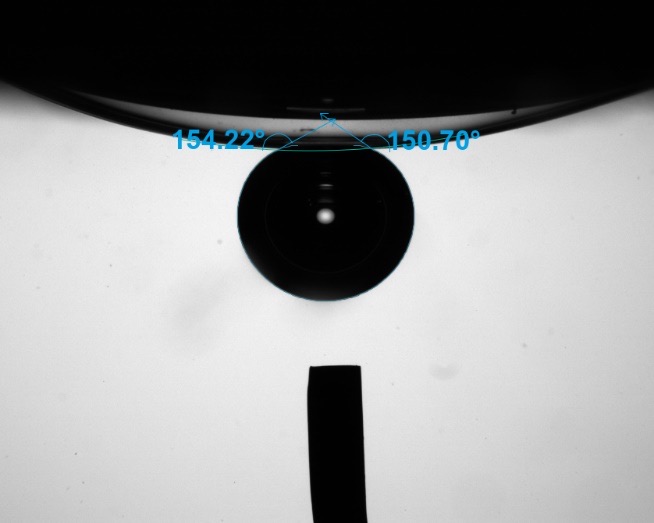
The next step was the search for a plastic that was sufficiently gas-permeable. The lens material also had to be well wettable by tear fluid. It must not serve as a breeding ground for bacteria or fungi and, unlike glass or other plastics, should be as shatterproof and scratch-resistant as possible. Additionally, the material had to be resistant to cleaning agents.
Furthermore, high transparency was required, with no discoloration over time. Even after prolonged wear, it should not release any toxic substances that could harm the eye. Allergens also had to be excluded.
Pure silicone initially seemed ideal, but due to its poor wettability, it caused what is known as sterile keratitis. The search for an ideal lens material continued; today’s so-called hard or rigid gas-permeable contact lenses consist of mixtures of various plastics.
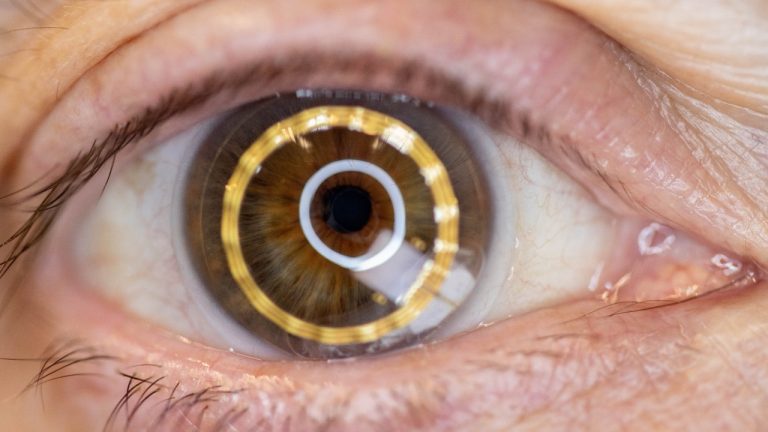
Today, the rigid, highly gas-permeable corneal lens is a popular alternative to glasses worldwide. It is the first-choice visual aid when eyeglass lenses, for example in cases of high myopia, hyperopia, or astigmatism, can no longer adequately correct the refractive error. Even in pathological shape changes of the cornea such as keratoconus or keratoglobus, as well as in corneal scars, the contact lens is indispensable due to its corset effect. Only in fitting-related problem cases is the significantly larger corneoscleral lens still used today; it has largely been replaced by the corneal lens. Refractive surgery also offers an alternative to glasses and traditional contact lenses, with modern lens implants, such as those used in pseudophakia, having been developed from the corneal lens.
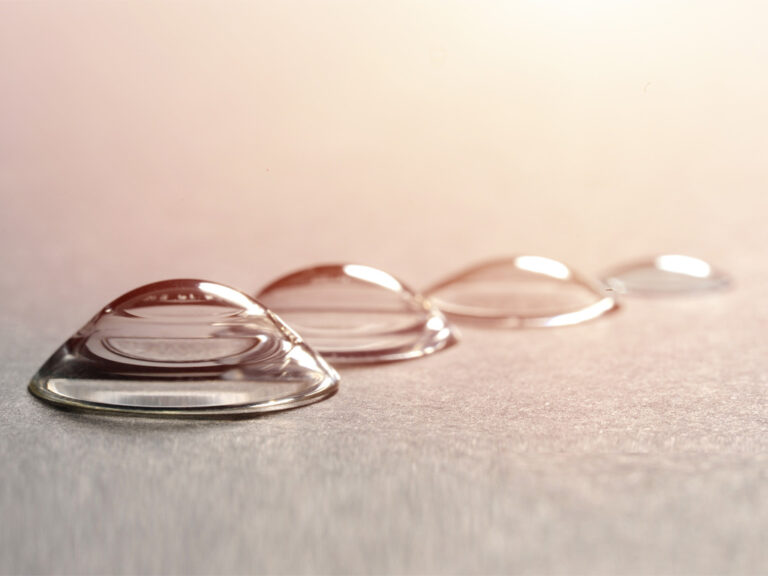
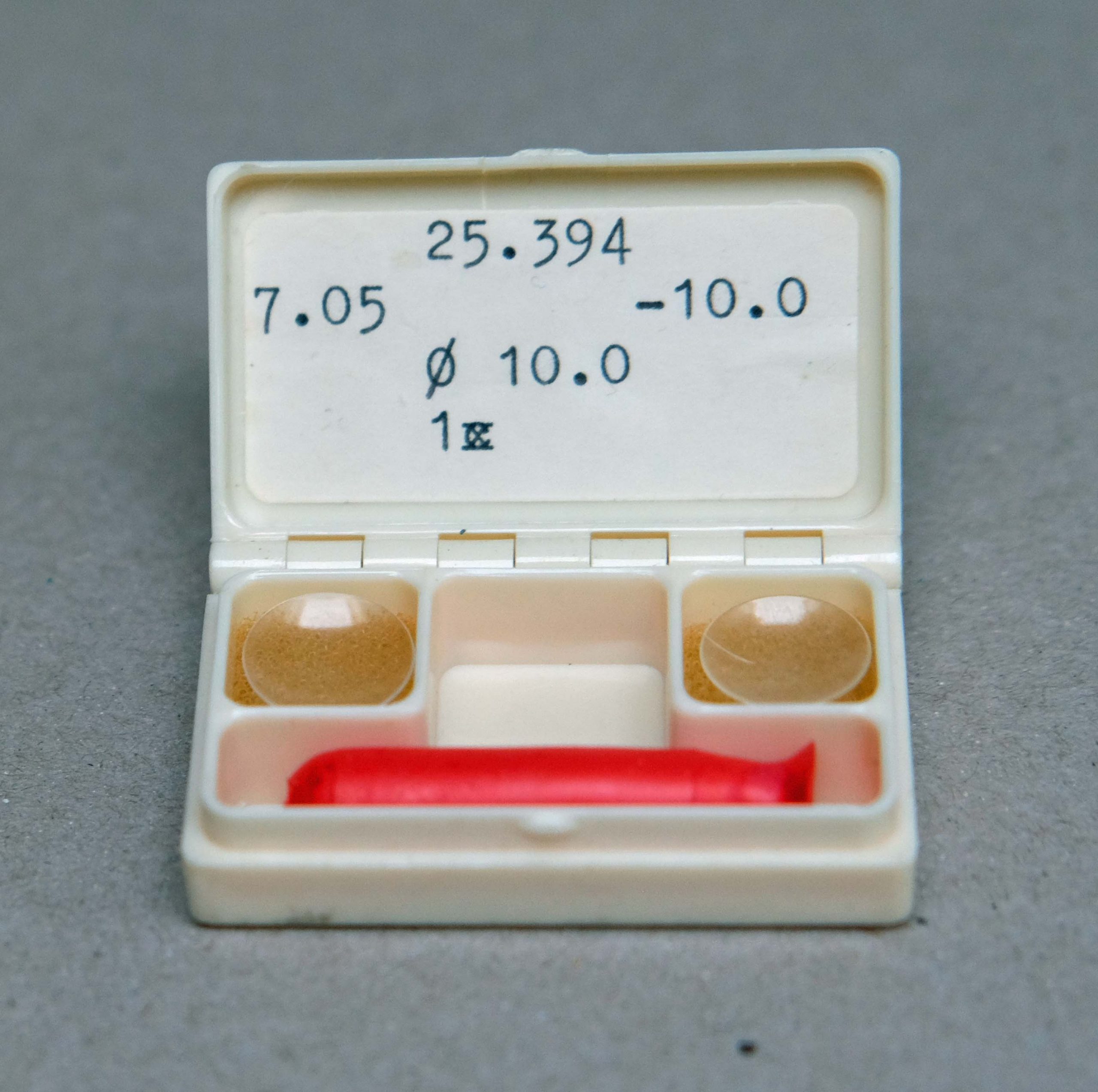
The classic hard contact lens made of PMMA shown here, along with its original storage container still preserved, comes, as the fitting data indicate, from a patient with keratoconus from around 1960. It was manufactured and distributed at the time by the company Wöhlk.